- Home
- Sandwich Panel Line
- Roll Forming Machine
- CZ Purlin Roll Forming Machine
- Door Window Curtain Partition Roll Forming Machine
- Gutter Roll Forming Machine
- Clean Partition Panel Machine
- Corrugated Panel Roll Forming Machine
- Double Layer Roof Roll Forming Machine
- High Speed Keel Roll Forming Machine
- Light Steel-Frame Structure Production Line
- C Channel Roll Forming Machine
- Insulated Panels
- Steel Profiles
- About
- Contact
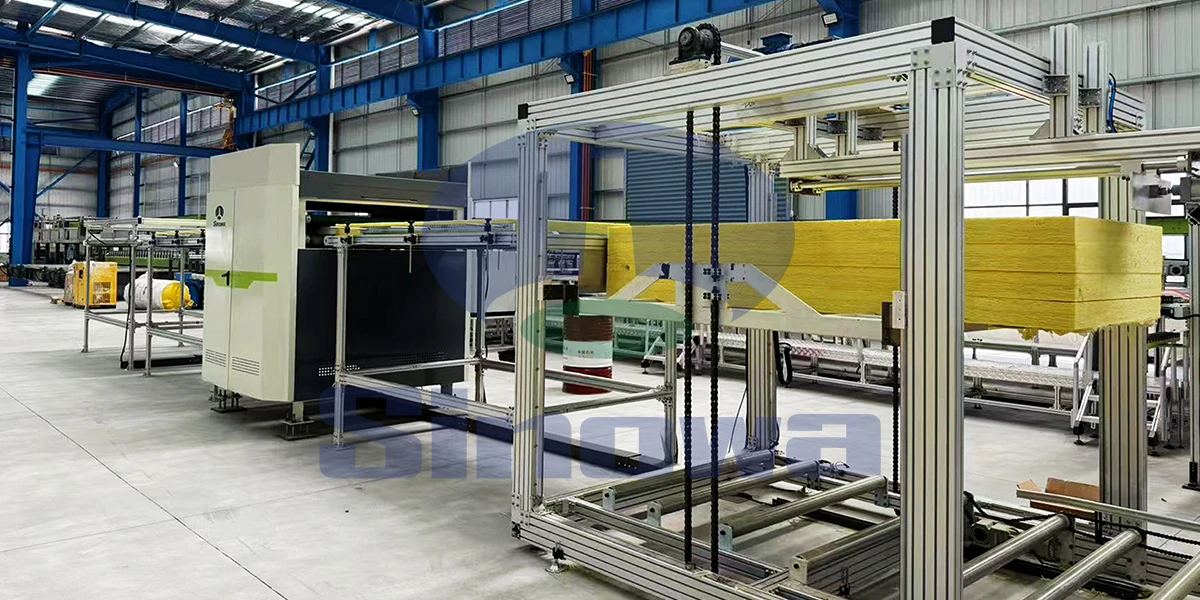
Rock Wool Sandwich Panel Production Line
Sinowa is a supplier and manufacturer of Rock Wool Sandwich Panel Production Line in china, customization on demand width a reasonable price.
Rock wool sandwich panel production lines are integrated automated systems designed to manufacture high-performance composite panels with rock wool as the core material, combined with various surface materials to meet diverse industrial and construction needs. These production lines integrate multiple advanced technologies, including mechanical engineering, electrical control, hydraulic technology, and material processing science, realizing continuous and efficient production from raw material feeding to finished product stacking. Unlike traditional manual or semi-manual production methods, modern rock wool sandwich panel production lines feature modular design, intelligent control, and high adaptability, which not only ensures the consistency and stability of product quality but also significantly improves production efficiency and reduces operational complexity. The structure, performance, types, and applications of these production lines are closely interrelated, each link complementing and promoting each other to form a complete production system that can adapt to different scales of production and product requirements.
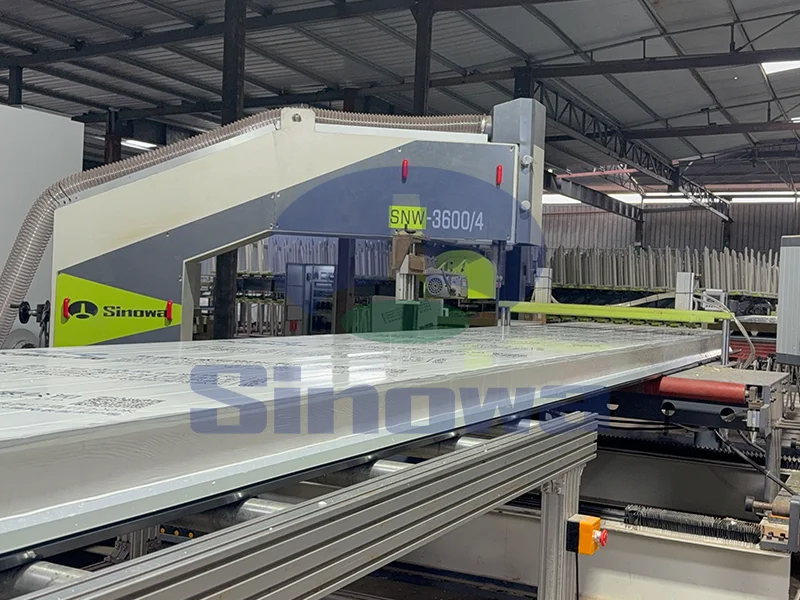
The structure of a rock wool sandwich panel production line is a modular integrated design, composed of multiple functional units that work closely together to complete the entire production process. Each functional unit has a clear division of labor and close coordination, ensuring the smooth operation of the production line. The core structural components usually include the uncoiling system, surface material forming system, rock wool processing system, adhesive application system, composite molding system, cutting system, conveying system, stacking system, and central control system. The uncoiling system is the starting point of the production line, mainly responsible for stably unwinding surface materials such as color-coated steel plates, aluminum alloy plates, or glass magnesium plates from coils, and conveying them to the next process through guiding devices. The uncoiling system is usually equipped with an expanding air shaft to adjust the tension of the material, ensuring that the surface material is unwound smoothly without wrinkles or deviations, which lays a foundation for the subsequent forming and composite processes. Some advanced uncoiling systems also have automatic deviation correction functions, which can real-time adjust the position of the material to avoid edge misalignment during the conveying process.
The surface material forming system is responsible for processing the unwound surface materials into the required shape and size. According to the different types of surface materials and product requirements, this system can adopt roll forming, stamping forming, or other processing methods. For example, when using color-coated steel plates as surface materials, the roll forming machine uses a series of precision rollers to gradually bend the steel plates into corrugated, flat, or other specified shapes, and the forming process is controlled by a frequency conversion motor to ensure the uniformity and accuracy of the shape. The surface material forming system is also equipped with film lamination, trimming, and punching devices. The film lamination device can attach a protective film to the surface of the material to prevent scratches or corrosion during processing and transportation; the trimming device trims the edges of the formed surface material to ensure the neatness of the width; the punching device can punch holes of specified sizes and positions according to the installation needs of the finished panels, improving the convenience of on-site installation. The rock wool processing system is a key part of the production line, responsible for processing rock wool raw materials into core materials that meet the thickness, density, and size requirements. Rock wool raw materials, usually in the form of slabs or rolls made of natural volcanic rock through high-temperature melting and fiber spinning, are first conveyed to the slitting device, where they are cut into strips of specified widths by an automatic slitting system. The slitting system is equipped with high-precision cutting tools and positioning devices, which can ensure the accuracy of the slitting width and avoid unevenness or waste of materials. After slitting, the rock wool strips are conveyed to the shaping device, where they are adjusted to the required thickness and density, and the fiber direction is optimized—usually arranged vertically to enhance the mechanical strength and thermal insulation performance of the final panel. Some advanced rock wool processing systems also include dust collection devices to reduce the dust generated during processing, ensuring a clean production environment and protecting the health of operators.
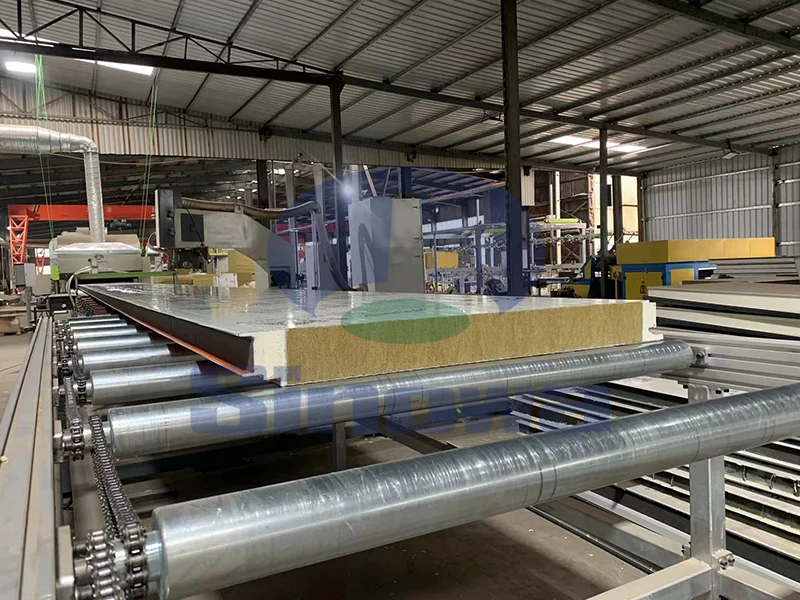
The adhesive application system is essential for ensuring the bonding strength between the surface materials and the rock wool core. This system usually consists of upper and lower spraying units, which use high-pressure spray guns to evenly spray adhesive on the inner surface of the upper and lower surface materials. The adhesive used is usually a two-component polyurethane system or other high-performance adhesives, which have strong bonding strength, good weather resistance, and high temperature resistance, and can form a firm combination between the surface materials and the rock wool core, even under harsh environmental conditions. The adhesive application system is equipped with a flow control device, which can adjust the amount of adhesive sprayed according to the thickness of the rock wool core and the type of surface materials, ensuring uniform bonding without excessive or insufficient adhesive. Excessive adhesive will cause waste and may affect the performance of the panel, while insufficient adhesive will lead to poor bonding, delamination, or peeling of the panel during use. The composite molding system is responsible for combining the upper surface material, rock wool core, and lower surface material into an integrated sandwich panel. The three-layer structure formed by the surface materials and the rock wool core is conveyed to the double-belt conveyor, where it is pressed and heated. The double-belt conveyor uses upper and lower pressure belts to apply uniform pressure to the sandwich structure, ensuring that the three layers are closely bonded. At the same time, the heating device heats the structure to accelerate the curing of the adhesive, improving the bonding strength and stability of the panel. The temperature and pressure of the composite molding process are precisely controlled by the central control system, which can be adjusted according to the type of adhesive and the thickness of the panel to ensure the quality of the composite.
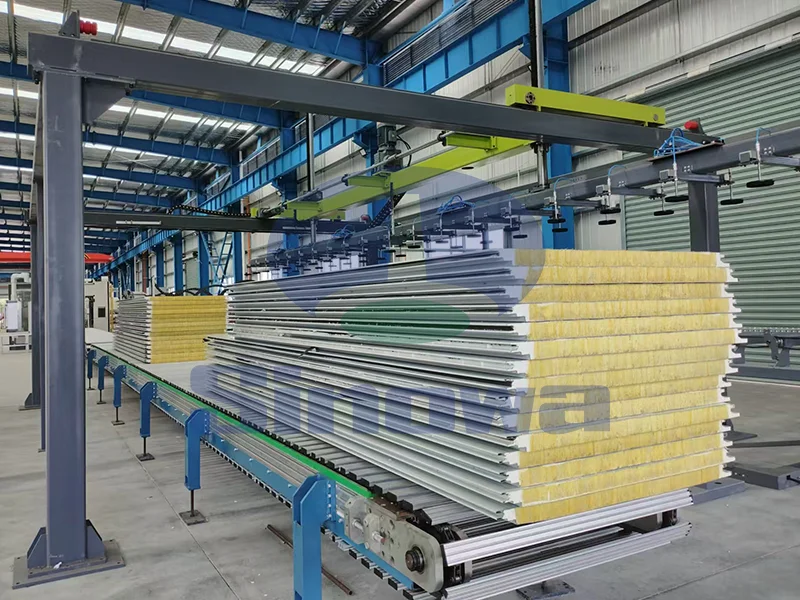
The cutting system is used to cut the continuous composite sandwich panel into finished products of specified lengths. Modern production lines usually adopt automatic cutting systems, which can realize non-stop cutting during the production process, ensuring the continuity of production and improving efficiency. The cutting system is equipped with high-precision cutting tools, such as circular saws or band saws, which can cut the panel smoothly without burrs or damage to the surface. The cutting length can be set freely through the central control system, and the cutting accuracy can reach a high level, meeting the installation requirements of different projects. The conveying system runs through the entire production line, responsible for conveying materials and semi-finished products between various functional units. The conveying system is usually composed of roller conveyors, belt conveyors, or chain conveyors, which are selected according to the characteristics of the materials and the production process. The conveying speed is synchronized with the production speed of each functional unit, ensuring the smooth flow of the production process. The stacking system is responsible for neatly stacking the cut finished panels, which is convenient for storage and transportation. Advanced stacking systems adopt automatic stacking technology, which can adjust the stacking height and arrangement according to the size and weight of the panels, reducing manual labor and improving stacking efficiency. The central control system is the "brain" of the entire production line, integrating PLC control, human-machine interface, and frequency conversion vector technology. Operators can set production parameters, monitor production status, and adjust production processes through the human-machine interface. The central control system can realize real-time monitoring of each functional unit, timely alarm for faults, and record production data, which is convenient for production management and quality control. Some advanced central control systems also have remote monitoring and fault diagnosis functions, which can help operators solve problems in a timely manner and reduce production downtime.
The performance of a rock wool sandwich panel production line is mainly reflected in efficiency, precision, stability, adaptability, and environmental protection, which directly determine the quality of the finished panels and the economic benefits of production. Efficiency is one of the core performance indicators of the production line. Modern rock wool sandwich panel production lines adopt continuous automated production methods, with production speeds ranging from 3 to 8 meters per minute, and some advanced lines can even reach higher speeds. The annual production capacity can reach 500,000 to 1,000,000 square meters based on 250 to 300 working days per year and 10 working hours per day, which is suitable for large-scale manufacturing operations. The high efficiency of the production line is mainly due to the modular design, intelligent control, and coordinated operation of each functional unit, which reduces manual intervention and avoids production interruptions caused by manual operations. Precision is another important performance indicator, which affects the size accuracy and quality consistency of the finished panels. The production line has high precision in each link, such as the slitting accuracy of the rock wool core, the forming accuracy of the surface materials, the adhesive application accuracy, and the cutting accuracy. The slitting accuracy of the rock wool core can reach ±1mm, the forming accuracy of the surface materials can ensure the uniformity of the shape and size, and the cutting accuracy can meet the requirements of different project installations. The high precision of the production line is ensured by advanced processing equipment, precise positioning devices, and intelligent control systems.
Stability is crucial for the long-term operation of the production line. The production line is made of high-quality materials and components, with a reasonable structural design and strict quality control, which can ensure stable operation for a long time. The modular design makes it easy to maintain and replace components, reducing the downtime caused by equipment failures. The central control system can monitor the operation status of each functional unit in real time, timely find potential faults, and send alarm signals, so that operators can handle them in a timely manner. The adaptability of the production line refers to its ability to produce different types, specifications, and sizes of rock wool sandwich panels to meet diverse market demands. The production line can adjust production parameters according to the requirements of surface materials, rock wool core density, panel thickness, and length, realizing the production of multiple products with one line. For example, it can produce flat or corrugated panels, panels with different surface materials such as color steel plates and glass magnesium plates, and panels with rock wool core density ranging from 100 to 150 kg/m³ and thickness ranging from 50 to 300 mm. The strong adaptability of the production line enables enterprises to quickly respond to market changes and improve their market competitiveness. Environmental protection is an increasingly important performance requirement in modern production. Rock wool sandwich panel production lines are equipped with dust collection devices, waste recycling systems, and other environmental protection facilities to reduce the impact on the environment. The dust collection device collects the dust generated during the rock wool processing process, avoiding air pollution; the waste recycling system recycles the waste materials generated during production, such as leftover rock wool and surface materials, reducing resource waste and environmental pollution. In addition, the adhesive used in the production line is usually environmentally friendly, non-toxic, and harmless, meeting the requirements of environmental protection standards.
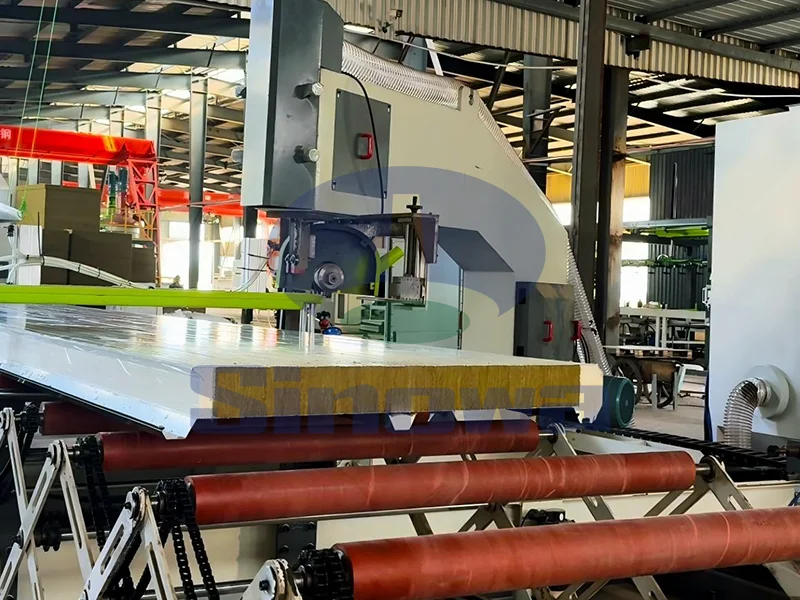
Rock wool sandwich panel production lines can be divided into different types according to various classification standards, such as production mode, product type, and automation level, each with its own characteristics and applicable scenarios. According to the production mode, they can be divided into continuous production lines and intermittent production lines. Continuous production lines are suitable for large-scale mass production, with high production efficiency, stable product quality, and low labor intensity. The entire production process is continuous, from raw material feeding to finished product stacking, without manual intervention in the middle, which is widely used in large enterprises. Intermittent production lines are suitable for small-scale production or customized production, with flexible production methods, low investment costs, and the ability to adjust production processes according to product requirements. However, their production efficiency is relatively low, and the quality consistency of products is not as good as that of continuous production lines. According to the type of finished products, rock wool sandwich panel production lines can be divided into roof panel production lines, wall panel production lines, and cleanroom panel production lines. Roof panel production lines are mainly used to produce rock wool sandwich panels for roof construction, which have good waterproof, windproof, and thermal insulation performance. The surface materials of roof panels are usually corrugated color steel plates, which can enhance the load-bearing capacity and waterproof performance of the roof. Wall panel production lines are used to produce rock wool sandwich panels for wall construction, which have good thermal insulation, sound insulation, and fire resistance performance. The surface materials of wall panels can be flat or corrugated color steel plates, glass magnesium plates, etc., which can meet the decorative and functional requirements of different walls. Cleanroom panel production lines are specialized in producing rock wool sandwich panels for cleanroom environments, such as medicine, food, and electronics factories. These panels have high cleanliness, non-toxicity, and corrosion resistance, and the production process adopts clean production technology to ensure that the panels meet the cleanliness requirements of cleanrooms.
According to the automation level, rock wool sandwich panel production lines can be divided into fully automatic production lines, semi-automatic production lines, and manual production lines. Fully automatic production lines adopt advanced intelligent control technology, with high automation level, and the entire production process is completed automatically by equipment, requiring only 5 to 13 operators to monitor and operate the equipment. These production lines have high production efficiency, stable product quality, and low labor costs, which are the development direction of modern rock wool sandwich panel production. Semi-automatic production lines require a certain amount of manual intervention, such as manual feeding of rock wool core materials, manual adjustment of equipment parameters, etc. Their production efficiency is between fully automatic and manual production lines, and the investment cost is relatively low, which is suitable for small and medium-sized enterprises. Manual production lines rely mainly on manual operations, with low production efficiency, high labor intensity, and poor product quality consistency, which are gradually being eliminated by the market. In addition, according to the processing technology of the rock wool core, rock wool sandwich panel production lines can be divided into dry-process production lines and wet-process production lines. Dry-process production lines use rock wool slabs as raw materials, which are directly slit and shaped, with simple production process, low energy consumption, and environmental protection. Wet-process production lines use rock wool fibers and binders to mix and shape, which can produce rock wool cores with higher density and strength, but the production process is more complex and the energy consumption is higher.
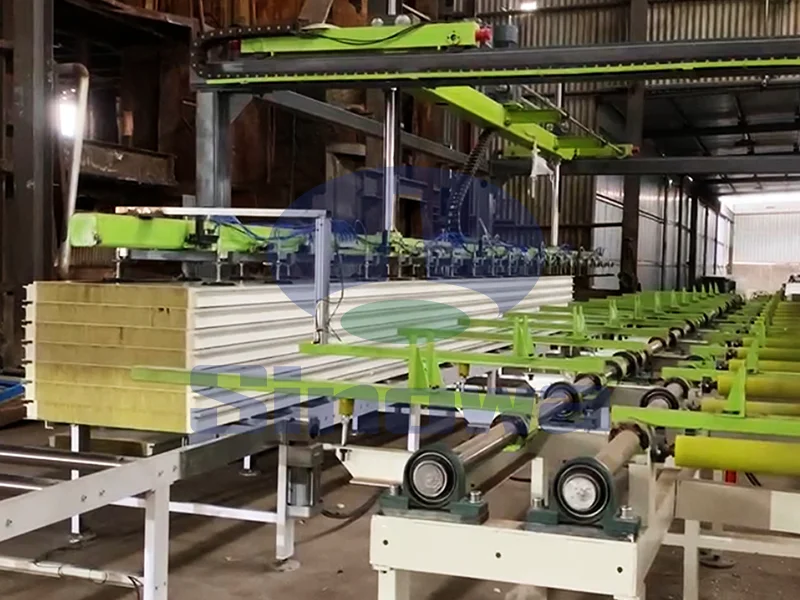
The applications of rock wool sandwich panel production lines are closely related to the performance of the rock wool sandwich panels they produce. Rock wool sandwich panels have excellent properties such as fire resistance, thermal insulation, sound insulation, light weight, high strength, and corrosion resistance, so they are widely used in construction, industrial, agricultural, and other fields, and the production lines that manufacture these panels also have a broad application prospect. In the construction field, rock wool sandwich panels produced by the production lines are widely used in the exterior walls, interior partitions, roofs, and floors of various buildings, such as residential buildings, commercial buildings, office buildings, hospitals, schools, and stadiums. In cold regions, these panels can effectively reduce heat loss and improve the thermal insulation performance of buildings, reducing energy consumption for heating and air conditioning. In fire-prone areas, the excellent fire resistance of rock wool sandwich panels can improve the fire safety level of buildings, delaying the spread of fire and reducing fire losses. In addition, rock wool sandwich panels have good sound insulation performance, which can reduce noise pollution and create a comfortable living and working environment. In the industrial field, rock wool sandwich panels are used in the construction of industrial plants, warehouses, workshops, and cold storage. Industrial plants, especially those with high temperature, high humidity, or corrosive environments, require building materials with good thermal insulation, corrosion resistance, and fire resistance, and rock wool sandwich panels can meet these requirements. Warehouses used to store flammable and explosive materials need to use fire-resistant materials, and rock wool sandwich panels are an ideal choice. Cold storage requires building materials with excellent thermal insulation performance to maintain the low-temperature environment inside, and rock wool sandwich panels have good thermal insulation effect, which can reduce the energy consumption of cold storage operation.
In the agricultural field, rock wool sandwich panels are used in the construction of greenhouses, livestock houses, and agricultural warehouses. Greenhouses require building materials with good thermal insulation and light transmission performance to create a suitable growth environment for crops, and rock wool sandwich panels can meet these requirements, helping to improve crop yield and quality. Livestock houses require building materials with good thermal insulation, sound insulation, and corrosion resistance to provide a comfortable living environment for livestock, reducing the incidence of diseases and improving the survival rate of livestock. Agricultural warehouses are used to store agricultural products, seeds, and agricultural machinery, requiring building materials with good moisture-proof, corrosion-resistant, and fire-resistant performance, and rock wool sandwich panels can meet these needs. In addition, rock wool sandwich panels are also used in the construction of temporary buildings, such as activity board houses, construction site offices, and temporary hospitals. These temporary buildings require fast construction, easy disassembly, and good performance, and rock wool sandwich panels have the advantages of light weight, quick installation, and good performance, which are very suitable for temporary building construction. With the continuous development of the construction and industrial fields, the demand for rock wool sandwich panels is increasing, and the application scope of rock wool sandwich panel production lines is also expanding. In addition, with the continuous improvement of environmental protection requirements and the promotion of energy-saving policies, rock wool sandwich panels, as energy-saving and environmental protection building materials, will have a broader market prospect, and the demand for rock wool sandwich panel production lines will also continue to grow.
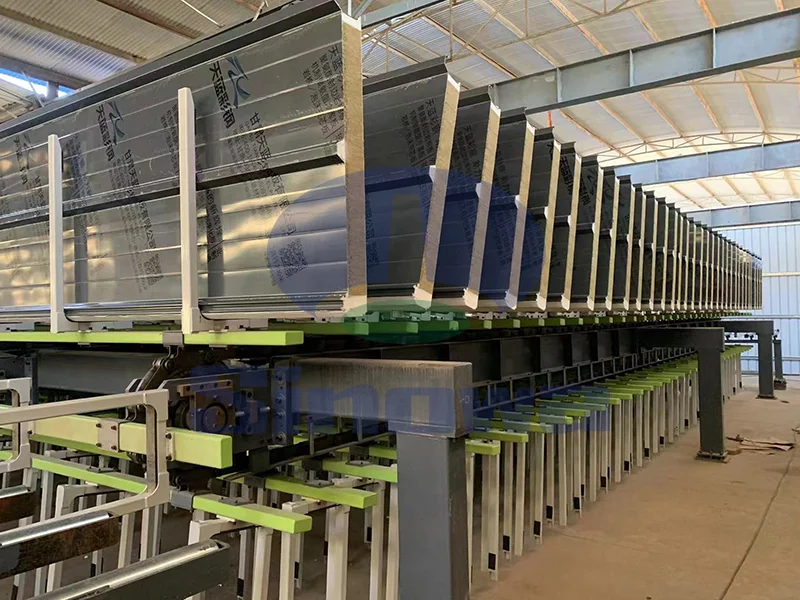
In summary, rock wool sandwich panel production lines are advanced automated production systems that integrate multiple technologies, with reasonable structural design, excellent performance, diverse types, and broad applications. The modular structure of the production line ensures the flexibility and maintainability of the equipment, the high efficiency and precision ensure the quality and output of the products, and the diverse types can meet the needs of different production scales and product requirements. The wide application of the production line covers various fields such as construction, industry, and agriculture, providing important support for the development of these fields. With the continuous progress of technology, rock wool sandwich panel production lines will develop in the direction of higher automation, higher precision, more environmental protection, and stronger adaptability, further improving production efficiency, reducing production costs, and promoting the sustainable development of the rock wool sandwich panel industry. Enterprises can choose suitable rock wool sandwich panel production lines according to their own production scale, product requirements, and market positioning, so as to improve their market competitiveness and achieve better economic and social benefits.
« Rock Wool Sandwich Panel Production Line » Update Date: 2026/4/15
URL: https://m.sinowa.cn/blog/rock-wool-sandwich-panel-production-line.html
Rock Wool Sandwich Panel Production Line Factory
2026-07-27Rock wool sandwich panel production lines represent advanced integrated manufacturing systems dedicated to the automated and continuous production of high-performance composite building panels. Combining mechanical transm…Rock Wool Sandwich Panel Production Line From China
2026-05-25China’s rock wool sandwich panel production lines have emerged as a core pillar of the global lightweight building material manufacturing industry, delivering integrated, automated, and high-stability manufacturing solut…Rock Wool Sandwich Panel Production Line Supplier
2026-04-15In the rapidly evolving modern construction industry, the demand for efficient, safe, and sustainable building materials has driven continuous innovation in production technology. Among these materials, rock wool sandwich…Polyurethane Rock Wool Sandwich Panel Production Line
2026-03-20The polyurethane rock wool sandwich panel production line stands as a highly integrated, automated manufacturing system designed to produce composite building panels that merge the structural rigidity of metal facings, th…Automation Of Rock Wool Sandwich Panel Production Line
2026-03-09In the modern construction and building materials sector, rock wool sandwich panels have emerged as a cornerstone material, prized for their exceptional thermal insulation, fire resistance, sound absorption, and structura…PU Rock Wool Sandwich Panel Production Line
2026-03-06The PU rock wool sandwich panel production line stands as a sophisticated and integrated manufacturing system tailored to the mass production of high-performance composite building panels, merging the structural rigidity …Rock Wool Sandwich Panel Production Line For House
2025-12-01Steel Edge Sealing Rock Wool Sandwich Panel Production Line
2025-09-02Rock Wool Sandwich Panel Production Line Exporter
2024-04-15High Quality Rock Wool Sandwich Panel Production Line
2024-04-15
A pu sandwich panel line stands as a highly efficient and automated production solution dedicated to manufacturing high-performance insulated panels, playing a vital role in modern construction and industrial engineering sectors. This integrated production system streamlines the entire manufacturing process, starting with the uncoiling and leveling of outer facing materials, which are carefully treated to ensure flat, smooth surfaces free of defects and suitable for subsequent bonding. Next comes the core production step: precise mixing and uniform distribution of polyurethane raw materials, where specialized equipment controls the ratio and flow rate strictly to guarantee consistent foam density and stable bonding performance between the core and facings. The pu sandwich panel machine features a controlled curing and forming system that maintains stable temperature and pressure conditions, allowing the polyurethane foam to fully expand, solidify and bond tightly with the upper and lower layers, forming a rigid, durable sandwich structure. Post-forming, the panels go through accurate cutting and finishing processes to meet diverse size specifications demanded by different projects. Designed for continuous operation, this pu sandwich panel production line boosts manufacturing efficiency remarkably while ensuring uniform product quality across batches, reducing manual errors and material waste effectively. The finished PU sandwich panels deliver outstanding thermal insulation, sound absorption and structural strength, making them widely applicable in building roofs, walls, cold storage facilities and industrial workshops, adapting to various environmental and functional needs with reliable performance and long service life.