- Home
- Sandwich Panel Line
- Roll Forming Machine
- CZ Purlin Roll Forming Machine
- Door Window Curtain Partition Roll Forming Machine
- Gutter Roll Forming Machine
- Clean Partition Panel Machine
- Corrugated Panel Roll Forming Machine
- Double Layer Roof Roll Forming Machine
- High Speed Keel Roll Forming Machine
- Light Steel-Frame Structure Production Line
- C Channel Roll Forming Machine
- Insulated Panels
- Steel Profiles
- About
- Contact
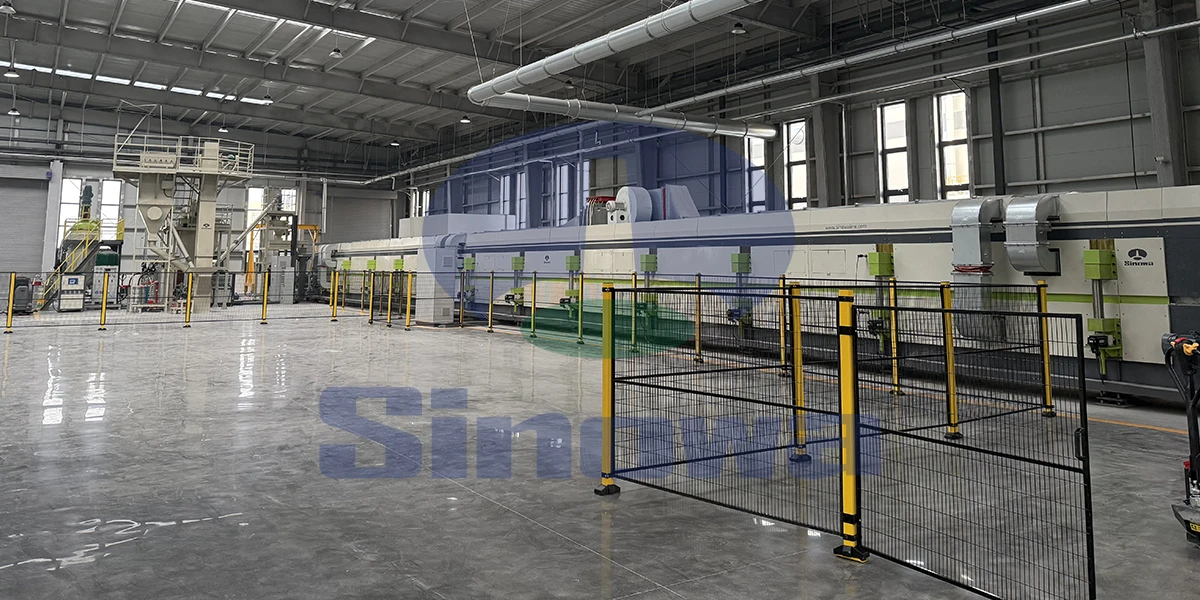
Phenolic Sandwich Panel Production Line
Sinowa is a sandwich panel production line supplier from china, design and custom-made sandwich panel production line, know more about phenolic sandwich panel production line, pls contact us, we will contact you as soon as possible!
The phenolic sandwich panel production line represents a sophisticated and integrated manufacturing system dedicated to the continuous fabrication of high-performance composite building panels, which consist of rigid phenolic foam core materials bonded firmly between two layers of flat or profiled outer facing materials. As a core manufacturing solution for modern energy-saving and fire-resistant building materials, this production line integrates raw material proportioning, continuous foaming, automatic laminating, constant-temperature curing, precise shaping, fixed-length cutting and post-finishing processing into one streamlined workflow, realizing large-scale, stable and standardized production of phenolic sandwich panels with consistent structural performance and surface quality. Different from ordinary sandwich panel production equipment, the production system tailored for phenolic materials features specialized temperature control logic, pressure adjustment mechanisms and material reaction management modules, fully adapting to the unique chemical foaming and cross-linking curing characteristics of phenolic resin, and effectively avoiding common production defects such as uneven core density, interfacial delamination, surface cracking and dimensional deviation that easily occur in traditional processing modes.
Continuous Insulation Panel Production Line of the PU and phenolic aldehyde surface has diversified and multifunctional production characteristics, which may produce products with different specifications such as PU, PF, PIR, etc. The surface material may be aluminum foil, colored steel, cement base cloth, kraft paper, non-woven fabrics, etc. The products are widely applied to such occasions as construction, decoration, pipeline ventilation, subway construction, etc. The Insulated Panel Machine of soft layer insulation board is able to continuously and efficiently produce high-quality PU and Phenolic insulation boards.
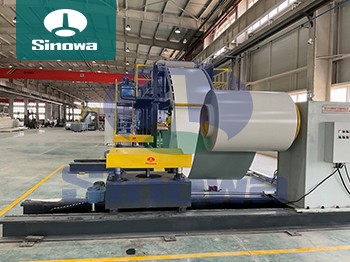
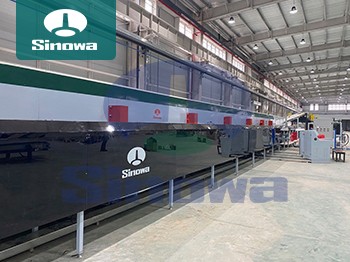
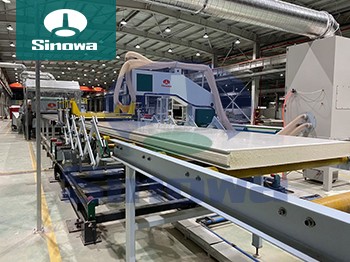
Sinowa is a well-known manufacturer and technical service provider of high-end PU Sandwich Panel Machines and various high-performance Cold Roll Forming Machine in China. Our main products include polyurethane double-sided color steel Sandwich Panel Production Line, polyurethane and phenolic soft facing insulation panel production line and high-efficiency roll forming lines.
Sinowa is committed to the development and manufacturing of high-end and high-efficiency Sandwich Panel Lines. Our production lines are leading the way in efficiency, automatic control, human-computer interaction, environmental protection and energy consumption. Using system integration and bus control technology, it realizes the automatic integrated linkage control of the entire production line, and can achieve remote interactive communication, which has the world-class level and a comprehensive leading high-performance production line in the market.
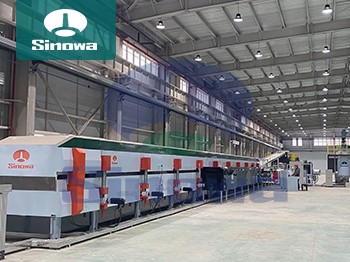
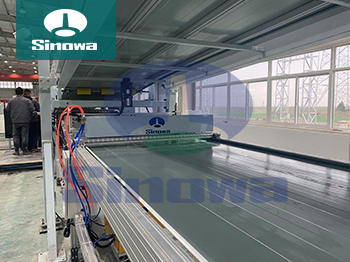
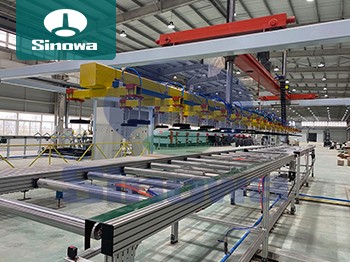
For more than ten years, we have never deliver two same lines to our client, there are all the crystallization of continuous improvement, we have been trying to surpass ourselves, create better products to serve our customers, and also accumulate our brand value, become a unique Chinese enterprise, we are no longer synonymous with low price and mediocre quality.
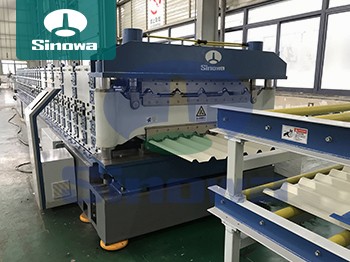
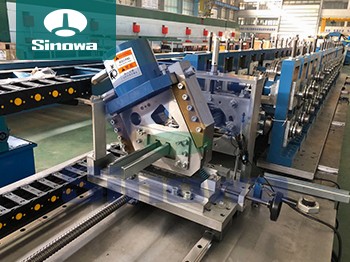
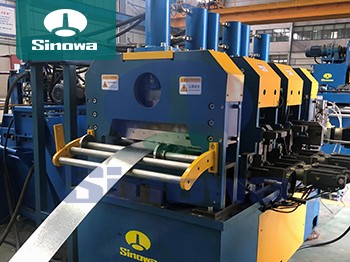
Since 2014, we have established our Cold Forming Machine design and manufacturing department, started our R&D and production of high-end cold forming equipment. Base on our innovative and high-end and efficient product concepts,In just a few years, we have created our own impressive achievements in this field. Whether ordinary construction products of Roll Forming Machine, or precision steel pipe equipment, elevator profile equipment, automotive profile equipment, precision door and window profile equipment, we are the leader of Chinese equipment with high efficiency, high quality and beautiful appearance design.
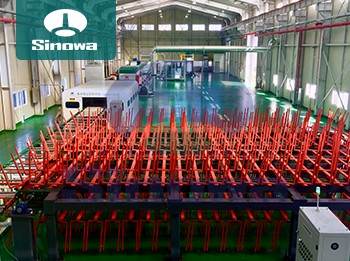
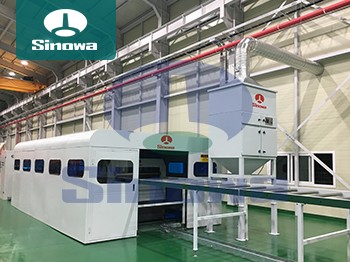
For more than ten years, relying on our innovative manufacturing concept and excellence in quality, reliable and trustworthy service to customers, we cooperate with customers all over the world, exported products to Canada, South Korea, Israel, Australia, the Middle East and other more than 20 countries and regions. contributed to building energy conservation and low-carbon production and have won widespread praise.
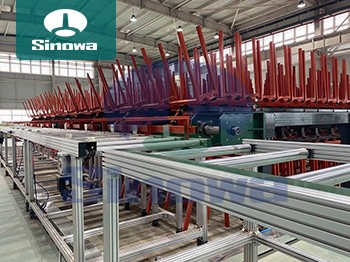
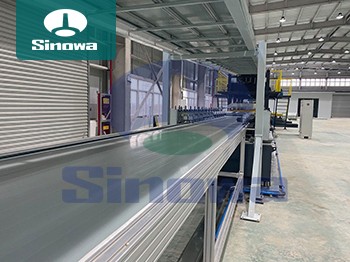
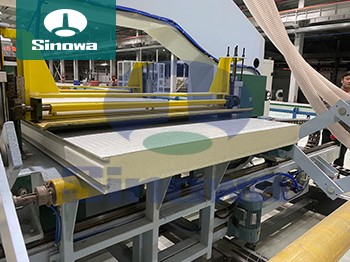
Sinowa has invested outstanding efforts in both the Continuous Insulated PU Sandwich Panel Production Line and the Roll Forming Line, This is why our products are more efficiency, quality, automatic control technology, environmental protection, energy consumption indicators and the appearance and safety protection are comprehensively leading, Some subversive design changes in many major technical points,these major innovations make our products excellent in price/performance and user experience.
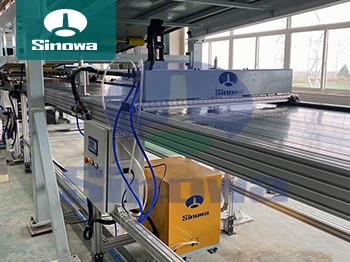
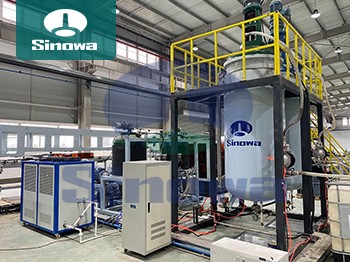
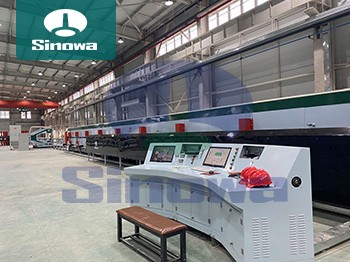
We always position our PU Sandwich Panel Line in a very high standard, strictly optimize every design for more progress. Our continuous innovation, continuous improvement of the technical design principles make us improved product updates and always pay attention to high efficiency, energy saving and stability, reduce customer worries, become their reliable business partners.
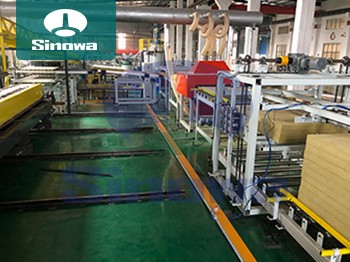
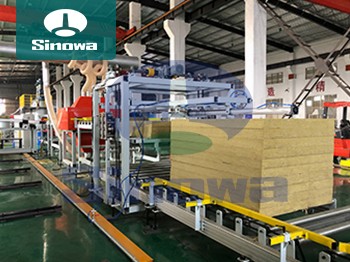
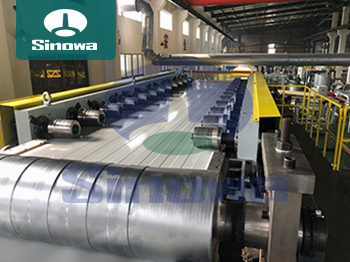
Sinowa Engineering Technology Research Center has always focused on technology research and development. we achieved a large number of scientific research results and unique patented process technology in related product research and development t every year, we continuously improve our products to have high precision and high stability in practical applications, and provide high quality for customers all over the world. Excellent technical personnel, continuous R&D investment and the technical concept of "continuous innovation and continuous improvement" are the strong guarantee for Sinowa to stand out from competitors.
Our focus is not on cost, we always pay attention to the quality of the product and how to do it better!
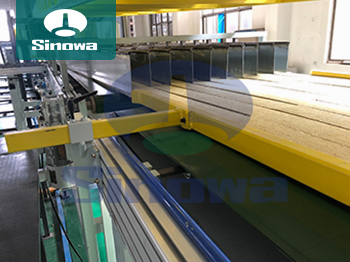
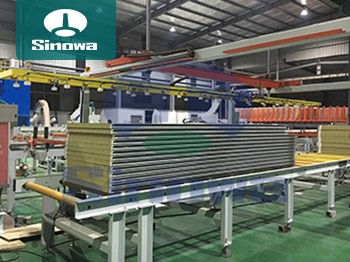
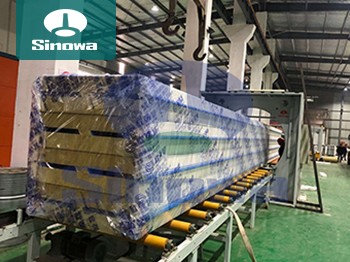
Production process control is a core part of implementing product planning and implementing quality control, which we establish A full range of production management processes and product logistics systems. We firmly believe that production without control and rules will only produce garbage products, so we pay more attention to first-class production control training while establishing a first-class production workshop, strictly follow the 5S management concept, establish systems and standards, ensure that our Sandwich Panel Machines are qualified throughout the process, achieve the technical goals of the company's products to achieve our brand value.
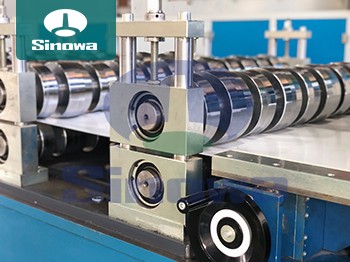
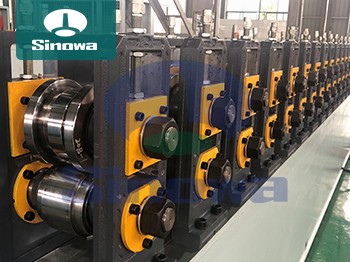
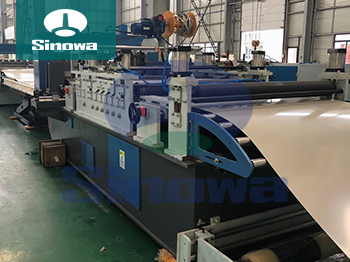
Sinowa has a very comprehensive quality control system, has a group of professional quality control personnel, familiar with almost all testing methods and standards in the field of machining, established a complete mechanical and chemical laboratory with which can fully control all quality links and ensure that all data are accurate, timely optional and available.
Relying on our good Sandwich Panel Machine quality and trustworthy service, our products are exported to more than a dozen countries in the world, and the service field continues to expand, winning more and more praise. Every customer will be our best friend!
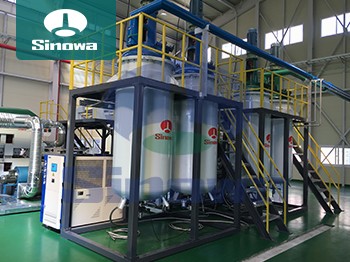
The entire production workflow starts with scientific raw material preparation and precise proportioning, which lays a fundamental foundation for the final performance of phenolic sandwich panels. The core raw materials include phenolic resin base materials, composite foaming components, functional auxiliary additives and high-efficiency bonding substances, all of which need to be screened and proportioned according to fixed process ratios to ensure stable chemical reaction activity and uniform physical properties of the foam core. In the automated feeding stage, multiple sets of sealed conveying and metering devices independently transport different raw material components to the centralized mixing unit, eliminating manual weighing errors and material contamination risks. The closed mixing system adopts high-speed rotating stirring structures to achieve homogeneous blending of liquid and auxiliary materials, maintaining a constant material viscosity and reaction activity through real-time temperature monitoring of the mixing cavity. This precise batching and mixing process ensures that the subsequent foaming reaction proceeds stably, enabling the formed phenolic foam core to achieve uniform cell structure, moderate density and excellent structural toughness, which are key prerequisites for the panel’s thermal insulation, flame retardancy and compression resistance.
After uniform material blending, the mixed phenolic composite materials are continuously and quantitatively poured onto the lower facing material that is stably conveyed by the automatic conveyor system. The outer facing materials used for production are usually high-toughness flat sheets with good flatness and surface uniformity, which are pre-treated through surface cleaning and anti-deformation calibration processes in the early conveying stage to remove surface dust, impurities and subtle warping deformation. The precise pouring system controls the material output rate and pouring range in real time according to the preset panel thickness specifications, ensuring that the phenolic raw materials are evenly paved on the surface of the lower facing material without accumulation or missing areas. Meanwhile, the auxiliary leveling device spreads the poured materials horizontally to form a uniform preliminary foaming layer, avoiding local thickness differences caused by material accumulation and ensuring the overall consistency of the panel core structure. In this stage, the running speed of the conveyor line is matched with the material pouring speed in real time through linkage control, realizing synchronous operation of material conveying and quantitative feeding and maintaining the continuity of the entire production process.
The continuous double-belt pressing and curing system serves as the core functional unit of the entire phenolic sandwich panel production line, determining the bonding strength, dimensional stability and comprehensive mechanical properties of finished panels. Different from the rapid curing process of other foam sandwich panels, phenolic resin requires gradual and stable temperature rise and constant-temperature cross-linking reaction to complete full foaming and curing, so the production line is equipped with a multi-stage temperature zoning curing chamber with independent temperature adjustment functions. The internal space of the curing chamber is divided into multiple temperature gradient zones, realizing slow temperature rise, constant-temperature curing and gentle cooling processes in sequence, which effectively prevents thermal shock damage to the phenolic foam structure and avoids quality problems such as core cracking, hollowing and incomplete cross-linking curing caused by excessive temperature fluctuation. The upper and lower double-belt structures adopt synchronous circulating operation, with precise gap adjustment functions to adapt to panel production requirements of different thicknesses. The stable pressure generated by the double-belt operation ensures close fitting between the upper facing material, phenolic foam core and lower facing material, eliminating gaps at the composite interface and achieving seamless integrated bonding of the three-layer structure.
During the continuous pressing and curing process, the intelligent control system dynamically monitors and adjusts key production parameters including curing temperature, operating pressure, belt running speed and material reaction state in real time. Each temperature zone in the curing chamber maintains an independent constant-temperature state, forming a scientific temperature gradient matching the phenolic foaming and cross-linking reaction rhythm. In the early foaming stage, moderate low-temperature heating promotes uniform expansion of the phenolic material and forms a fine and closed cell structure; in the middle curing stage, constant high temperature accelerates the cross-linking reaction of phenolic resin, improving the structural strength and dimensional stability of the foam core; in the later stabilizing stage, gradual cooling eliminates internal stress generated during high-temperature processing, preventing subsequent deformation and warping of finished panels. The whole curing process is completed in a fully enclosed environment, which not only ensures the stability of the reaction environment but also reduces material loss and avoids the impact of external dust and air flow on panel molding quality.
After completing continuous curing and preliminary shaping, the integrated phenolic sandwich panel enters the precise trimming and fixed-length cutting stage. The continuous plate body conveyed from the curing system first passes through the edge trimming unit, which removes the irregular residual materials on both sides of the panel through high-speed rotating cutting tools to ensure consistent width and neat edge structure of the entire panel. The trimming speed is synchronously linked with the conveyor running speed, realizing non-stop continuous edge finishing and effectively improving production efficiency while ensuring flat and smooth panel edges without burrs or collapse defects. Subsequently, the intelligent tracking crosscutting device automatically identifies the conveying position of the plate body and performs fixed-length cutting according to preset dimensional parameters. The cutting system has high-precision positioning and error correction functions, which can automatically compensate for subtle conveying deviation to ensure that the length error of each finished panel is controlled within a tiny range. The entire cutting and trimming process adopts automated non-contact detection and mechanical processing, avoiding manual operation errors and ensuring unified dimensional accuracy of batch products.
The post-processing unit of the production line includes surface finishing, defect inspection and stacked storage processes, further optimizing the overall quality and finished product state of phenolic sandwich panels. After cutting and shaping, the surface of the panel is finely polished and cleaned to remove tiny burrs, floating dust and residual attachments on the surface and edges, making the panel surface smoother and the overall appearance more uniform. The online inspection system conducts comprehensive real-time detection of each processed panel, covering surface flatness, structural integrity, interface bonding state and dimensional accuracy, automatically identifying and screening out individual products with subtle defects such as local delamination, surface scratches and dimensional deviation. Qualified panels are stably conveyed to the automatic stacking unit, which neatly stacks panels according to fixed specifications through mechanical clamping and positioning structures, effectively avoiding extrusion deformation and surface damage during stacking. The stacked finished panels are arranged in order for subsequent packaging and transportation, realizing seamless connection of the entire production process from raw material input to finished product output.
The core advantages of the modern phenolic sandwich panel production line are reflected in its high automation level, stable process control and excellent product consistency, which completely breaks through the limitations of traditional intermittent production equipment. The whole production process adopts centralized program control, realizing automatic linkage operation of feeding, mixing, pouring, composite pressing, curing, cutting and stacking, with minimal manual intervention in the production process. The intelligent parameter adjustment system can store multiple sets of mature process parameters corresponding to different panel thicknesses and structural specifications, enabling rapid switching of production modes according to market demand and greatly improving production flexibility. In terms of production stability, the closed-loop control of temperature, pressure and speed parameters ensures that the chemical reaction state and physical molding state of each batch of materials remain consistent, making the core density, cell structure, bonding strength and thermal insulation performance of finished panels highly unified in batch production.
In terms of production efficiency and energy consumption optimization, the integrated structural design of the production line effectively reduces intermediate material handling links and heat loss in the production process. The multi-stage heat preservation structure of the curing chamber reduces external heat dissipation, realizing efficient utilization of heating energy and reducing overall production energy consumption. The continuous circulating operation mode of the double-belt pressing system avoids repeated start-stop energy consumption of intermittent equipment and improves the continuous production capacity of the line. Meanwhile, the precise metering and feeding system effectively controls the usage of raw materials, reduces material waste caused by excessive feeding or unqualified products, and improves the overall material utilization rate of the production process. These optimized designs make the production line have significant advantages in large-scale batch production, meeting the mass supply demand of phenolic sandwich panels for engineering construction.
In terms of product performance shaping, the professional process logic of the phenolic sandwich panel production line endows finished panels with unique comprehensive advantages compared with other types of sandwich panels. The gradual cross-linking curing process of phenolic resin ensures that the foam core has high closed-cell rate and uniform cell distribution, giving the panel excellent thermal insulation and heat preservation performance, which can effectively block heat transfer and reduce building energy consumption. The high-strength composite bonding structure formed by continuous pressing and curing makes the interface between the outer facing material and the core layer have strong peeling resistance and shear resistance, ensuring that the panel can maintain stable structural performance under external pressure, bending and other external forces. In addition, the fully reacted and cured phenolic foam core has good flame retardancy, high temperature resistance and dimensional stability, and will not easily deform, melt or spread flame in high-temperature environments, meeting the high safety requirements of modern building enclosure structures, purification spaces and industrial thermal insulation facilities.
The production line also has good adaptability to diversified production demands, supporting the production of phenolic sandwich panels with different thickness specifications and different facing material types. By adjusting the gap parameters of the double-belt pressing system, material pouring volume and curing process parameters, the equipment can stably produce thin lightweight panels and thick high-strength thermal insulation panels, covering the application demands of different building scenarios. At the same time, the production process can be adjusted according to the performance requirements of finished products, optimizing the core density and curing degree of the panel, so as to produce panels with different thermal insulation coefficients and mechanical strength grades, realizing diversified product layout on a single production line and improving the comprehensive utilization value of production equipment.
In actual industrial production operation, the standardized process flow of the phenolic sandwich panel production line effectively guarantees the long-term stable operation of the equipment and the continuous optimization of product quality. The modular equipment structure facilitates daily maintenance and routine inspection of each functional unit, reducing equipment failure rate and downtime loss. The real-time data monitoring function of the control system can record all production parameter data in real time, providing accurate data support for production process optimization, product quality traceability and production efficiency improvement. Through long-term stable parameter control and process accumulation, the production line can continuously output high-quality phenolic sandwich panels with stable performance, uniform specifications and reliable quality, providing core material support for energy-saving building construction, industrial facility thermal insulation, clean space enclosure and other fields.
With the continuous upgrading of modern building energy conservation, safety and environmental protection standards, the market demand for high-performance phenolic sandwich panels is constantly increasing, which also promotes the continuous technological iteration of phenolic sandwich panel production lines. Modern production equipment is developing towards higher automation intelligence, more precise process control and more efficient energy-saving performance, further optimizing the foaming reaction efficiency, composite bonding effect and finished product stability of panels. While maintaining efficient production capacity, the optimized production process further improves the environmental protection level of production, reduces the generation of process waste and volatile substances, and realizes green and low-carbon production. As a key core equipment in the field of new building thermal insulation composite materials, the phenolic sandwich panel production line will continue to play an important role in promoting the standardized development and performance upgrading of the building material industry, and provide reliable technical and equipment support for the construction of high-quality energy-saving and safe modern buildings.
« Phenolic Sandwich Panel Production Line » Update Date: 2026/5/25
Tags: Glass Wool Sandwich Panel Production Line , Continuous Sandwich Panel Production Line , PIR Sandwich Panel Production Line , Rock Wool Sandwich Panel Production Line , Rockwool Sandwich Panel Production Line , Continuous PU Sandwich Panel Production Line , Polyurethane Sandwich Panel Production Line , PU Sandwich Panel Production Line , Sandwich Panel Production Line ,
URL: https://m.sinowa.cn/blog/phenolic-sandwich-panel-production-line.html
A pu sandwich panel line stands as a highly efficient and automated production solution dedicated to manufacturing high-performance insulated panels, playing a vital role in modern construction and industrial engineering sectors. This integrated production system streamlines the entire manufacturing process, starting with the uncoiling and leveling of outer facing materials, which are carefully treated to ensure flat, smooth surfaces free of defects and suitable for subsequent bonding. Next comes the core production step: precise mixing and uniform distribution of polyurethane raw materials, where specialized equipment controls the ratio and flow rate strictly to guarantee consistent foam density and stable bonding performance between the core and facings. The pu sandwich panel machine features a controlled curing and forming system that maintains stable temperature and pressure conditions, allowing the polyurethane foam to fully expand, solidify and bond tightly with the upper and lower layers, forming a rigid, durable sandwich structure. Post-forming, the panels go through accurate cutting and finishing processes to meet diverse size specifications demanded by different projects. Designed for continuous operation, this pu sandwich panel production line boosts manufacturing efficiency remarkably while ensuring uniform product quality across batches, reducing manual errors and material waste effectively. The finished PU sandwich panels deliver outstanding thermal insulation, sound absorption and structural strength, making them widely applicable in building roofs, walls, cold storage facilities and industrial workshops, adapting to various environmental and functional needs with reliable performance and long service life.